The Centre Pompidou and the Influence of Architecture on Disability Aesthetics

I knew, before Easter break, that I was interested in looking at certain of Henri Matisse’s paintings as texts for my final paper. In the hope of clarifying my project, I decided to try to see as many of Matisse’s cutouts as possible over the break, which I spent in Paris with the Art History department. I tried to be attentive to the issues of accessibility and disability rights throughout my stay in Paris, but on my way into the Centre Pompidou, the modern and contemporary art museum that houses many of Matisse’s works, my mind was particularly focused on disability. The fact that I was looking forward to examining the work of a disabled artist in person, and therefore had already been thinking of the Pompidou as the implicit home of a number of examples of works of disability aesthetics, perhaps explains my difficulty with the museum’s architecture and accessibility – elements that remained distinct in the building and its layout, preventing it, in my view, from truly becoming a “home” of the art of disabled artists. I was interested in attempting to examine the role of architecture not only in our perception of disability or disability aesthetics, but in the very range of our thought about embodied experience.

For those who don’t know the Centre Pompidou, it helps to understand that it functions not only as one of the world’s foremost modern and contemporary art museums, but also as a major landmark in Paris’ landscape, both physical and symbolic. The Pompidou’s architects were awarded the Pritzker Prize for their design, which is based on the principle of maximizing flexible interior space for the display of works. As a result, all of the functional organs of the building – water pipes, air ducts, electrical wiring, and, notably, transportation of people – were moved to its exterior, giving the façade its distinctive “high-tech” look (see the picture below). In many ways, in fact the architecture of the Pompidou transcends its art collection – the Centre Pompidou is, in fact, not only a museum, but a library and cultural center as well. For many of those who visit the Pompidou, the experience of traveling though the building – entering its belly on the ground floor, ascending the escalators encased in translucent glass, rising over the city’s landscape on the building’s exterior – is equally, if not more, important than the art at the end of the journey.

While I do not necessarily agree, I do think that the Pompidou provides an example of the way architecture can act as both a kind of spatial enactor or reinforcer of social assumptions regarding ability, and as a potentially unnoticed, but powerful, shaper of our thinking and embodiment. As Walter Benjamin argues, the tactile reception of architecture, which comes about “not so much by way of attention as by way of habit,” has the ability, surreptitiously, to mold the way we view art and the world (Benjamin goes as far as to argue that “this form of reception shaped by architecture [has] canonical value) (Benjamin 1069). For a building, like the Pompidou, that is intended to give unbiased shelter to a multiplicity of viewpoints and perceptions, this potentially corrupting force is particularly important. While the elevators are integrated into the façade, they are less easy to navigate as they appear (separate sets link different floors), and the clear “path” of the building privileges the escalators. Beyond the “added-on” feeling that this gives the building’s accessibility, it also excludes visitors with mobility disabilities from the “full” or “true” experience of the building. The implication of such design, moreover, is not limited to issues of physical accessibility; although disabled visitors are technically able to access the Pompidou’s collection, their exclusion from the building’s aesthetic and spatial design implies a larger lack of consideration of disability as a viable framework or component of art.

Do the architecture and accessibility of museums signify more meaningfully than those of other buildings for disability and disability aesthetics? How can existing architecture be “adapted” to not only provide access to disabled people, but include their perspectives in aesthetic design?


Works Cited


Walter Benjamin. “The Work of Art in the Age of Its Technological Reproducibility,” in The

            Norton Anthology of Theory & Criticism, ed. Vincent B. Leitch. New York: W. W.

Norton & Company, Inc., 2010.
Art and Knives

Before visiting Washington, I had never seen lobotomy knives in person.

I’m not sure that I ever want to again.


We were in a back room of the National Museum of American History surrounded by inventory of our nation’s cultural artifacts. I was mesmerized by the labels on drawers, the full glass cabinets, and Katherine Ott’s enthusiasm as she led us through the passages of items toward a center table. It’s surface was invisible, buried under a range of objects that provided a history of disability unlike any I had been aware of prior to Katherine’s presentation. She excavated so many facts and myths and unpublicized secrets about hearing aids, prosthetic limbs, glass eyes that I was overwhelmed and in awe of a material past I had known very little about. It is a past that is a major component of Disability Studies.


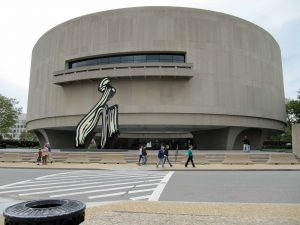
Earlier I had visited the Hirshorn Museum, its adjacent sculpture garden, and the national mall area itself. It was a morning spent exploring and deeply considering the presence of disability in the visual art and sculptures and accessibility of the structures and walking routes I was wandering. I’m an art dweeb. I was excited to spend time in room after room full of displayed art; to see the Wilhelm de Kooning paintings of mutilated female bodies, the Brancusi “Torso of a Young Man”, the uncaptioned Spanish video “Ser y Durar” featuring parkour artists in a cemetery. I realized what I was being drawn to were bodies, expressed in a way that wasn’t “normal” or familiar. I was looking at art that I had seen before on survey course slides or online images through a newly rendered Disability Studies lens. I was keenly aware of where the elevator was, at what eye level the title plaques were placed, and the order in which the art was laid out.Hirshhorn Museum Outside 10-3-10


The Hirshorn only had one handicap-accessible entrance on the building’s front Independence Avenue side. I didn’t have high hopes for the interior, but the design surprised me. The floors were all absolutely flat and the museum’s circularity becomes an equalizer to disabled and nondisabled visitors. You can either pass through the rooms clockwise or counter-clockwise. Whether you can move easily or not, there is a sense of funneling that doesn’t affect the order in which a person with full movement versus one who has an impairment would explore the art. I loved this. I loved that a person in a wheelchair, for instance, would select which pieces they wanted to see and in what order just as I was could. Starting points were subjective. Architecturally, I thought it was a simple, smart design.


The downside? The sculpture garden only has ramps on one side and forces those with limited access to follow a certain route through the various works (including pieces by Rodin and Matisse). It changes the viewing experience when someone doesn’t have the choice to approach art freely and in whatever order they please.


By the time we all met up at the Smithsonian and were gathered around those artifacts, my mind felt spent and submerged under a haze of disability thinking. It was what we were here in Washington, D.C. for.

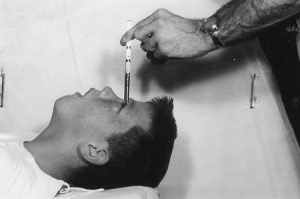
So, it could have been the long morning, the hours of being on my feet, or the the warmth of the back room we were standing in with Katherine Ott, but I know these are all excuses. When I felt pressure at the back of my eyes, and the tears leak out, it was only because I was intensely affected.  She was holding up these sharp, gleaming stainless steel lobotomy knives and they were resting in this blue velvet lined case like a diamond necklace would have. And all I could think about were the personalities erased and the lives changed with that knife’s point simply slipping in and severing prefrontal cortex connections on patients with mental disabilities or disorders. I was devastated. In a matter of moments a person who was deemed disabled or dysfunctional in society would undergo a procedure that was irreversible. icepick-lobotomy


Nothing compares to witnessing some of the material artifacts we were given access to. In person, I was able to take in the shine of metal and simplicity of design in what were essentially medical weapons. It is only in the second half of the 20th century that lobotomies have stopped being performed. It is only in the last decade or so that Disability has become an active rights movement. We’re slowly but surely opening up discussion and provoking thinking about Disabilities Studies and a minority group in the United States that deserves just as much attention as any other.

Observations from DC

Day 1: Holocaust Museum

I had known going into the museum that disabled individuals were among the first genocide victims in Nazi Germany.  I assumed that disabled bodies posed some sort of affront to the aesthetics of physical perfection the Nazis valued so much, but I never considered the erasure of disability on a social level.  Throughout the museum, quotations from German soldiers compared their state to a single living organism, and one officer referred to Hitler as “The great physician of our body politic.”   Non-Aryan members of society were imperfections that could only weaken an otherwise healthy body.  One display case actually ranked various races of the world in terms of their value to an ideal society.  Jews were considered the worst.  They were compared to parasites because they not only failed to contribute to the health of the social body, they also weakened other races (the quotation that explains this claim does not provide evidence to support it).  The entire Holocaust was an attempt to erase disability from German society, even after the focus of concentration camps shifted away from literally disabled persons.

Erasing disability was more than just an aesthetic choice.  It was also economic.  In addition to funding concentration camps, the German government was fighting a costly war.  Some of the first victims of disability genocide were elderly people in state-run facilities, and the decision to euthanize most of those patients came from a cost-benefit analysis of what they could provide economically vs the cost of care.  All the food an elderly person consumed was less food for the troops.

Day 1, part 2: American History Museum

Thanks to the wonderful Katherine Ott, one of the museum’s curators, our class got a behind the scenes look at many disability artifacts.  Katherine had them all laid out on a table for us to study, and then she presented each one.  Before explaining each artifact, she would ask the class to guess its function.  We finished with an abysmal record.  Some of the artifacts were exotic or absurd and looked nothing like modern versions.  Some of the most interesting artifacts were the ones designed to help disabled people pass for non-disabled.  For example, Katherine showed as a hearing aid consisting of an earpiece connected to a long tube.  Rather than include a bulky amplifier as part of the aid, people used to hook up their aids to amplifiers hidden in potted plants.  Katherine showed us a collection of glass eyes and explained how they were custom-fitted and colored.  She even showed us a “night eye” that was dilated for evening wear.  Katherine also had a few prosthetic legs.  One was colored to look like a caucasian leg and was fitted with a business shoe.  Another leg was clearly artificial and made of metal, but Katherine explained that it was much more comfortable and functional than the one made to pass.  The effort that people would put forth in order to pass, both in terms of money and hassle, illuminates the power of disability stigma in the time when these artifacts were used.

Day 2: Air and Space Museum

I searched for lapses in accessibility inside the museum, but couldn’t find anything significant.  Text in the display cases is low enough to be visible by someone in a wheelchair and every part of the museum is accessible by ramp or elevator.  There aren’t really any disability artifacts here.  Anyone who has seen GATTACA knows that disability has no place in space travel, at least not yet.  Astronauts have to be in perfect physical condition.  The one problem I had with accessibility is that the ramp on the Constitution Avenue side was far to the side of the building and required a significant detour for someone in a wheelchair to enter the museum.  This architectural choice made the museum seem somewhat unwelcoming, but at least they were not totally unwilling to accommodate their mobility-impaired guests.

Simulating and Storytelling

The Davidson Research Initiative trip to Washington, D.C. helped me address a question I have been curious about since before I even enrolled in English 494: Disability and Literature.

Last year, a campus speaker  talked about about an exhibition in Atlanta called “Dialogue in the Dark.” This exhibition aims to allow people experience what the world feels like in complete darkness. Visitors fumble around the room, touch different objects, and navigate people. Throughout this semester I have often thought the exhibit might be a good way to experience disability.

When we went to the Smithsonian, Katherine Ott showed us a table full of disability artifacts. There were cases of glass eyeballs, prosthetic legs, and the evolution of the hearing aid. We were allowed to look and take pictures of the artifacts, but I really wanted to touch the objects, put them on, and see how they felt.

Both “Dialogue in the Dark” and my desire to try on the artifacts point to the idea of simulating disability. Throughout the semester I’ve wondered whether Dr. Fox has ever incorporated some kind of disability simulation into the curriculum. Why not let students walk around with patches over their eyes to experience blindness or use a wheelchair for a month to see the frustrations associated with accessibility?

These questions led to a very fruitful discussion about the problems with simulating disability. Our group discussed the idea of wanting to experience disability in order to empathize, but we also  realized that wearing an eye patch or sitting in a wheelchair does not even come close to knowing what it is like live with a disability. These kinds of exercises often inspire pity rather than understanding and can lead participants to think that they “get it” when in reality, they have only been costuming disability and not truly living it.

Yet I couldn’t help but feeling like I got a taste of disability when I visited the Hirschhorn. We saw an exhibit by artist Barbara Kruger called “Belief + Doubt.” If you haven’t had a chance to see the exhibit, you can check out pictures on the Hirschhorn Museum website. Pictures, however, don’t do justice to the experience. The words are painted on the eighteen-foot walls in glaring black, white, and red. Reading a sentence requires enormous concentration, stepping back and taking in each letter slowly. I felt anxious when I was trying to read a line while other visitors – who were eager to take pictures without some random stranger in the foreground – tapped their feet and stared at me impatiently. Frustrated and embarrassed, I couldn’t help but think that this must be what it is like for people who have learning disabilities.

In a way, my eye-opening experience at the Hirschhorn and our discussion about simulation are at odds. Was my experience at the Hirschhorn a simulation? Did I overstepping the boundaries in claiming that it felt like having a learning disability? I think the experiences are different because I didn’t walk into the Hirschhorn with the agenda to understand what it feels like to struggle with reading or how bright colors can be over-stimulating to someone with autism.  I don’t claim to know what it feels like to have a disability, but by putting myself in an uncomfortable situation, I can better recognize that for me, this discomfort is temporary and avoidable while for many it is a lived experience.

While simulating disability isn’t a great way to show support or engage with disability issues, Katherine Ott helped me understand an important thing that all of us can do to support people with disabilities. She told us about an unmarked, mass grave that was discovered in Colorado a few years ago. None of the people who were buried in this grave were given any sort of honor or recognition – they were simply cast aside. You’d think something like this might make national news or at least be a little more well-known, but often cases like this one in Colorado and others are simply covered up. Katherine told us that these are the stories that stories that need to be told and we can bring these conversations to the surface. This discussion fired my interest in learning more about mass graves like the one in Colorado and finding a way to remember the individuals who were buried and tell their stories. For my final Disability and Literature Paper, I am writing a creative nonfiction piece on a mass, unmarked grave in Stockton, CA. I am really grateful to the Davidson Research Initiative because I think it helped me pair some of the theory and texts we’ve discussed in class with real people and real stories. I hope my project will not only help me make more real-world connections but also give some the individuals in Stockton a voice.


Dismantling Societal Policing of the Disabled

The Disability and Literature 2013 Class trip to D.C. was such an amazing and informative experience for me. In addition to visiting several amazing museums and viewing mind-blowing artifacts up close, we enjoyed our stay in the comfort of the beautiful Palomar Hotel. Our class spent two days diving deep into the topic of disability and how it has been perceived and handled in society. Washington, D.C. provided the perfect grounds for devoting time to study disability, as it is full of museums and artifacts that intersect with disability culture in a multitude of ways.

On our first evening in D.C., we had dinner with disability advocate Lawrence Carter-Long. Lawrence spoke about how his work in the arts (theater and dance), has influenced and impacted the disabled community. Lawrence’s work with “disTHIS”, which aimed at having several film screenings related to disability, prompted great discussion about the perception of disability in the disabled and non-disabled communities. Lawrence also spoke of his passion for the arts and how being a part of a dance project called “GIMP” allowed him to use dance as a way of expressing himself. As a disability advocate, Lawrence also readily spoke about legislation concerning accommodations for the disabled and what work still needs to be done. To be in Washington, D.C. where politics and legislation live, so to speak, really heightened the conversations we had with Lawrence about what needs to happen next in the Capital to make sure everyone’s needs are met. I found our conversation with Lawrence fascinating and very insightful. It was such an honor to have dinner with Lawrence and to be able to speak one-on-one with him about all the great work he’s done.

We had a fascinating Saturday looking at artifacts that society has developed to police and reshape disability with curator Katherine Ott. After thinking deeply about the artifacts we saw and the history they told, we were allowed to choose a museum of our choice on Sunday to explore concerning disability. We were to go out and ask ourselves “What is this museum saying about disability?”, “How does this museum address accessibility?, and “What does it say about the history of disability in its cultural context”? Among visiting the FDR Memorial, MLK JR. Memorial, and Air and Space museum, I narrowed my focus on the National American Indian Museum. One of the most striking things I found in the museum was how the Native Americans treated disability in their culture. There were several ceremonial dances they would do to gain honor from their community and be seen as worthy of completing certain tasks. I began to wonder how those with physical disabilities, who may not be able to dance, would be seen and interpreted in their communities? How would they go about obtaining honor for themselves and their families if they could not participate in these dances? I also noticed how some Native Americans would dance to also heal the intellectually and physically disabled of their community. The “cure method” was one that was held highly in their communities. It brought me back to how history and society have tried for so long to simply cure those with disabilities rather than try to understand and make accommodations for them. The museum also had small screens for children to watch old Native American folk tales on. One folk tale spoke of a young boy whose face was disfigured and thus was labeled as disabled and unable to accomplish anything in his community. It wasn’t until the Sun God removed the disfiguration on his face(thus removing his disability), that he got friends and even got married to the girl he loved (who had shunned him prior to). Once again, I did some thinking about what these folk tales say about the disabled and how they construct a negative view of them for children at a young age.

Being able to go to D.C. with my Disability and Literature class was one of the best Davidson experiences I’ve ever had. Being able to apply what I’ve been learning in class to something outside of the classroom was both challenging and rewarding. It totally changes your perspective and opens your eyes to the lives of others around you.

How to Add a Post

Instructions for Posting

1. Login using your WordPress ID. You can access the login page by clicking here, or navigating to the login link on the top of the homepage.

2. Once you have logged in, click Posts. Select Add New. 

3. Add a title for your post.

4. In the main text body, add your written content.

Helpful Tips:

  • Click “Show/Hide Kitchen Sink” for more formatting options
  • To paste from Microsoft Word, click the clipboard icon with the W. To paste from another text editor, click the clipboard icon with the T.
  • You can change the text formatting by choosing Headings in the dropdown menu.
  • Hovering over each icon will tell you what they do, if you get confused

5. Add whatever media you may want to include.

Adding an Image

  • In your post editor, select “Add Media” at the top left of your editor box.
  • After you’ve clicked this you can either a.) add an image from your hard drive (your own or downloaded) b.) use an image from a URL c.) add an image from your media library
  • To upload an image from your computer
    • Drag image into space or click “select files”
    • Title it and include alternate text. Caption is optional.
    • Choose alignment and size
    • Click “insert into post”
    • Save all changes and close out of the box
  • To insert an image from a URL
    • Paste the URL from the image or media
    • Follow steps above
  • To insert from the Media Library
    • Find the image you want (there are multiple pages) and click “Show”
    • Follow steps above

 Adding a YouTube Video

  • Once you’ve found the video you want to embed, copy the URL.
  • Simply paste it into your post in the regular text box NOT under featured video – unless you would like it to be featured.
  • Select Publish and then check to be sure it worked. If it did not, make sure the URL is on its own line.
  • If you are interested in embedding a Vimeo video or video from another site, check with Jenny Hall (jehall@davidson.edu)

6. Once your post is the way you want it, under categories choose your name.

7. Under Tags, type in a few words or phrases that you think summarize your post. Think in terms of general thematic ideas that relate to your post.

8. Below tags you will see a box for Featured Image. This is your final step. Click Set Featured Image.  Upload your image or find your image from the media library. You can use an image that you already used in your post. Once you’ve added the title and alternate title on the side bar, click Use as Featured Image. 

9. Back in the post editing page, click either Publish or Update (which appears if you have already clicked Publish).

10. Now view your post and see if it looks the way you want. If it doesn’t, you can always go back and edit. Just be sure to click Update again after you make any changes.


css.php