Before visiting Washington, I had never seen lobotomy knives in person.
I’m not sure that I ever want to again.
We were in a back room of the National Museum of American History surrounded by inventory of our nation’s cultural artifacts. I was mesmerized by the labels on drawers, the full glass cabinets, and Katherine Ott’s enthusiasm as she led us through the passages of items toward a center table. It’s surface was invisible, buried under a range of objects that provided a history of disability unlike any I had been aware of prior to Katherine’s presentation. She excavated so many facts and myths and unpublicized secrets about hearing aids, prosthetic limbs, glass eyes that I was overwhelmed and in awe of a material past I had known very little about. It is a past that is a major component of Disability Studies.
Earlier I had visited the Hirshorn Museum, its adjacent sculpture garden, and the national mall area itself. It was a morning spent exploring and deeply considering the presence of disability in the visual art and sculptures and accessibility of the structures and walking routes I was wandering. I’m an art dweeb. I was excited to spend time in room after room full of displayed art; to see the Wilhelm de Kooning paintings of mutilated female bodies, the Brancusi “Torso of a Young Man”, the uncaptioned Spanish video “Ser y Durar” featuring parkour artists in a cemetery. I realized what I was being drawn to were bodies, expressed in a way that wasn’t “normal” or familiar. I was looking at art that I had seen before on survey course slides or online images through a newly rendered Disability Studies lens. I was keenly aware of where the elevator was, at what eye level the title plaques were placed, and the order in which the art was laid out.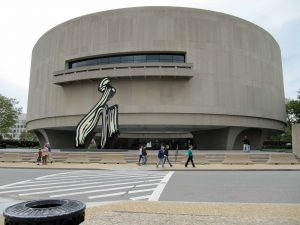
The Hirshorn only had one handicap-accessible entrance on the building’s front Independence Avenue side. I didn’t have high hopes for the interior, but the design surprised me. The floors were all absolutely flat and the museum’s circularity becomes an equalizer to disabled and nondisabled visitors. You can either pass through the rooms clockwise or counter-clockwise. Whether you can move easily or not, there is a sense of funneling that doesn’t affect the order in which a person with full movement versus one who has an impairment would explore the art. I loved this. I loved that a person in a wheelchair, for instance, would select which pieces they wanted to see and in what order just as I was could. Starting points were subjective. Architecturally, I thought it was a simple, smart design.
The downside? The sculpture garden only has ramps on one side and forces those with limited access to follow a certain route through the various works (including pieces by Rodin and Matisse). It changes the viewing experience when someone doesn’t have the choice to approach art freely and in whatever order they please.
By the time we all met up at the Smithsonian and were gathered around those artifacts, my mind felt spent and submerged under a haze of disability thinking. It was what we were here in Washington, D.C. for.
So, it could have been the long morning, the hours of being on my feet, or the the warmth of the back room we were standing in with Katherine Ott, but I know these are all excuses. When I felt pressure at the back of my eyes, and the tears leak out, it was only because I was intensely affected. She was holding up these sharp, gleaming stainless steel lobotomy knives and they were resting in this blue velvet lined case like a diamond necklace would have. And all I could think about were the personalities erased and the lives changed with that knife’s point simply slipping in and severing prefrontal cortex connections on patients with mental disabilities or disorders. I was devastated. In a matter of moments a person who was deemed disabled or dysfunctional in society would undergo a procedure that was irreversible. 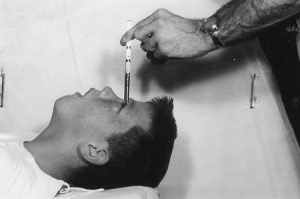
Nothing compares to witnessing some of the material artifacts we were given access to. In person, I was able to take in the shine of metal and simplicity of design in what were essentially medical weapons. It is only in the second half of the 20th century that lobotomies have stopped being performed. It is only in the last decade or so that Disability has become an active rights movement. We’re slowly but surely opening up discussion and provoking thinking about Disabilities Studies and a minority group in the United States that deserves just as much attention as any other.
