When I spontaneously chose to start my Sunday Funday of museum trips with the National Geographic museum, I hadn’t actually intended to find anything specifically disability related. Especially not when I stumbled across a side exhibit, hidden in a building that was shrouded by the shadow of the larger, “real” National Geographic building, called something like “Best Nat Geo Unpublished Photos of 2012.” Of course, as the cliché so often goes, I couldn’t have been more wrong.
Almost all of the small number of shafted photos that dotted the intimate yet open space touched on disability studies in wonderfully unconventional ways. The first photo I saw depicted two identical twins, women dressed in (unsurprisingly) identical goth-Western garb. Of course they had to be in identical garb–and exaggerated costumes no less. Their styling worked perfectly for the photographer because it emphasized the mirroring effect of the final photo. As these women took a break from the carnavalesque characters they were playing, seemingly pausing from their typical work, the overall mirroring effect (the two women faced one another in mime-like poses) that the photographer created poked fun at the myth that identical twins have no autonomy, that they are simply the same being and the same consciousness repeated in two bodies.
Another photo that immediately captured my eye was one of a South American native. With a face half splintered by darkness, which, according to the side blurb, supposedly reflected the exoticized mystique of his jungle home, the man visibly reflected the mystery of his mental illness. In fact, besides his native heritage, his mental illness became the only other identifying feature. Without the aid of “civilized” medicine, the caption suggested, this man’s illness splintered his identity–quite visibly, and perhaps to the detriment of his physical health.
Of all the photos, though, the one that most attracted my attention was the photo of quilombos (hidden societies) in Brazil. Foregoing the mystery commonly associated with secret societies, this picture also plays off some exoticized stereotypes of non-Western cultures. The picture focused on female escaped slaves dancing around a single, small candle in religious celebration. The shadows from the roof played with the proportions and fluidity of their dresses, dividing them into uneven parts. This unevenness reflected the women’s supposed mental instability. The reporter/photographer claimed that, in this moment of emotional euphoria, the women had entered “trances.” These trances were supposedly so powerful that they affected the photographer’s own method’s of reporting. The women’s rapid and unpredictable movements forced him to photograph “like crazy” — the frenzy so overwhelming that it left nothing untouched. One of the men’s trances was also so intense that he apparently had to rest “awhile” before bringing the photographer away from this ceremony and into un-crazy normalcy. What most struck me, though, was seeming balance between mental and physical states for these women in this moment. Their frantic bodies oozed the craziness within. Each “trance” suggested some kind of uninhibited access.
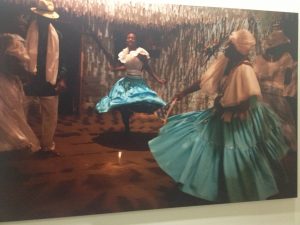
One of many eye-catching pictures in the entire National Geographic exhibit. Brazilian women in the quilombo community of Santa Rosa dos Pretos engaged in a religious ceremony.
I most loved that this visit emphasized the multiple readings one photograph can provide. And the readings weren’t necessarily mutually exclusive. Each picture was rife with different interpretations that created their own complimentary, separate picture. Even in the most unexpected places (and exhibits), disability studies forced me to engage with art in more fruitful and truly unrestricted ways. Though it shouldn’t have had to, disabled identity continued to prove its prevalence and complexity.
